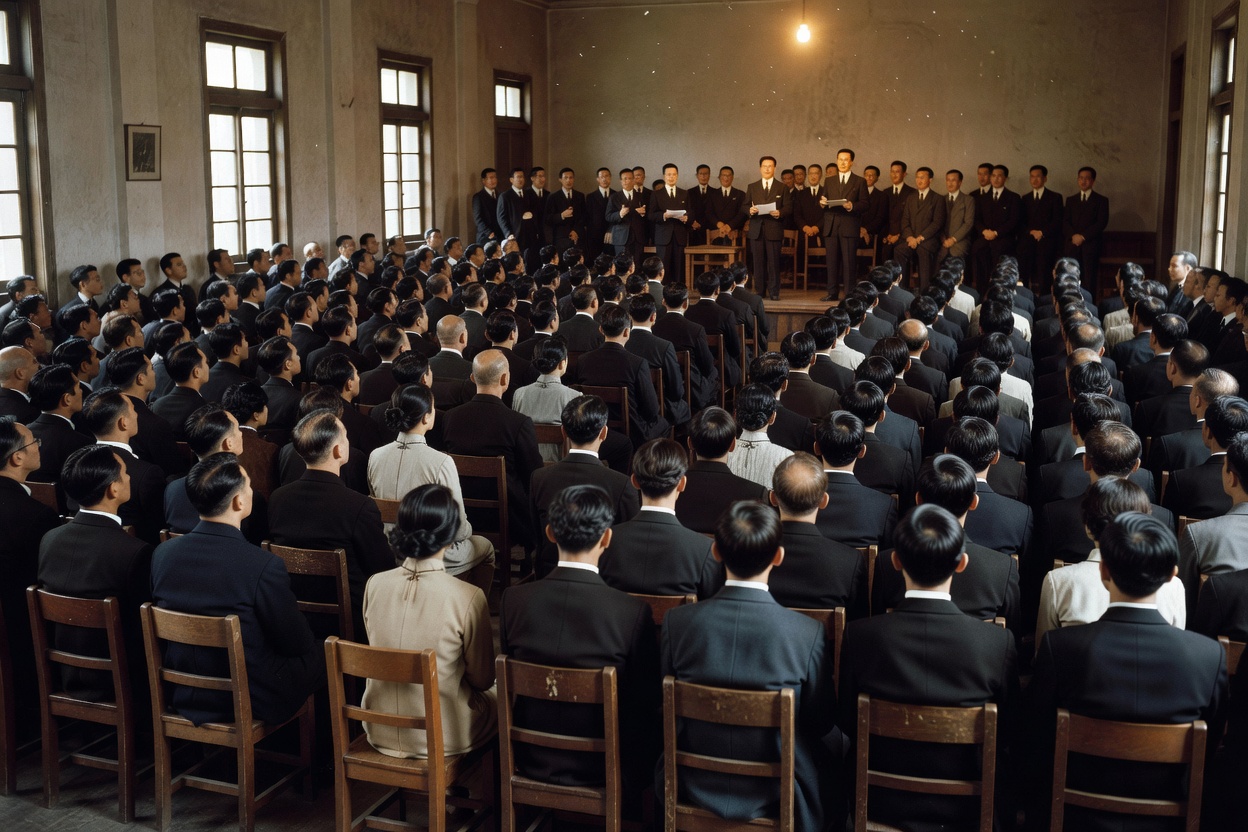
They gathered at Jingxiu Girls’ School in Dadaocheng on a Monday afternoon. More than three hundred people filled the hall. Lin Hsien-tang was named prime, Chiang Wei-shui the managing director, and roughly a thousand members were already listed. Doctors, landlords, teachers, and students who had studied in Japan sat in the same room.
Armed resistance had mostly ended by 1915. The new tactic was cultural. The association’s charter said its purpose was to help Taiwanese culture advance. They set up reading rooms so people could hear the newspapers the Japanese authorities did not want them to read. They ran lecture tours. In 1925 alone the police counted more than three hundred talks. Summer schools taught law, Western history, and sociology. A drama troupe traveled the island. Chiang Wei-shui, a doctor, wrote a “clinical lecture” that diagnosed the island itself as a patient under colonial rule. The first issue of the association bulletin was banned.
The group split in 1927. One side wanted gradual reform inside the Japanese system. The other pushed harder class politics. The original association faded. What remained was the habit of public argument. Taiwan Culture Day is now marked on 17 October.
The school building is gone. The district is full of cafes and restored shophouses. The meeting itself lasted one afternoon. The petition movement that ran alongside it lasted fourteen years and fifteen submissions to the Japanese Diet. None of them produced a local parliament. The lectures did produce an audience that expected to hear arguments in public.
Wikipedia has the basic outline. The chairs in that school hall were ordinary wood. The people who sat in them were not.